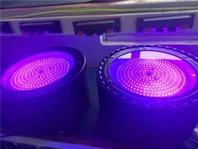
The Story of Two Bulbs

It doesn't take long when looking around for LED bulbs to find significant differences in wattage, pricing, and warranties. Many people are interested in their distinctions. Even if there are more and more high-quality, high-performing LED items available every day, quite a few of them aren't made to last or function well.
An LED light bulb is technologically far more similar to a consumer electronics gadget than it is to a standard filament-based light bulb. When looking for an LED bulb, it's wise to keep in mind that you wouldn't hold the same expectations for a $30 camera as you would for a $300 camera. A viable LED lighting solution must include a number of essential components, and any lightbulb is only as strong as its weakest connection.
an LED chip
The type, quality, and arrangement of the chips are crucial because they are what truly produce light in an LED bulb. They are often put onto a layer of heat-conducting material, also known as a wafer. High light output and color uniformity required for usage in general illumination are characteristics of high-quality chips. They differ significantly from those employed in applications with smaller output.
Moreover, chips come in a variety of color temperatures and light outputs when they are created. They are then binned, or separated according to grade. The chips in the best or "tightest" bins have the highest level of color and light output consistency; as a result, they cost the most to purchase. To ensure that their product is constant from bulb to bulb, the most reliable producers will only use these chips. The remaining bins, which are utilized in many of the inexpensive LEDs on the market, are less expensive but also far less reliable. Some of the most disreputable products on the market don't even use lighting-specific chips, but rather a variety of low-power chips similar to those used in indicator lights.
power control
The voltage and current flowing from the socket are transformed into what the LED chip needs to produce light by the power management system, also known as the driver. It functions similarly to how fluorescent and HID lamps' ballasts do. If this system is improperly built, the chip could be underpowered, which would lead to early failure, or overpowered, which would lead to poor light output.
Management of Heat
LED chips produce heat, which needs to be removed from the parts and dissipated in order to prolong the life of the chip and the driver assembly. The heat management system, usually referred to as a heat sink, is responsible for carrying out this task. There are many various heat sink designs in use, but the majority of them all feature aluminum fins that protrude from a metal core. These kinds of metal castings are frequently used in the industry because metal easily transfers heat.
Lens
The LED chip does not always direct the light it produces in the direction that is required. The lens's role is to focus and steer light so that it "lands" where it should. Particularly important in reflector style lamps is the lens (like PAR and MR types).
The Story of Two Bulbs
Now that you know how an LED bulb functions, let's have a look at two LED options that can both replace halogen PAR38 bulbs up to 90 watts.
Comparing LED and Halogen lighting sources
We have a Philips 16PAR38 LED, which is available on our website, on the left. An LED bulb that we received as a sample from a manufacturer that wanted us to resell their product may be seen on the right. We decided against carrying this item, and we believe you will understand why soon.
The black piece in the center of the Philips bulb is a sizable metal heat sink. It has a lens that appears to have been created with the intention of concentrating the light coming from the eight high-power chips visible just below the lens. The entire enclosure was obviously made with using it as an LED reflector bulb in mind.
The other bulb appears to have no heat sink whatsoever. The lens looks like it was not designed to be used with an LED bulb; it is the same as the lens of a halogen PAR38. Instead of anything made expressly to be used as illumination, it includes roughly 25–30 chips that appear to be the same low-power type and are employed as indicator lights. In actuality, the entire bulb appears to be made up of a few dozen LED chips that have been inserted inside the same halogen bulb housing.
Let's light them up and see what happens.
Halogen and LED lamps are lighted side by side.
A warm, bright light is produced by the Philips light bulb. The light's color and quality are pretty equivalent when compared side by side with those of a halogen bulb. On the other hand, the sample bulb emits a cool, faint light. It's almost blue, not just "cool white". There is no discernible direction to the light that is being produced. Although the bulb itself is lighted, there isn't much light coming from it, similar to an LED sign. It is light you can see but not light you can see by, to put it another way.
Conclusion
This is an extremely extreme comparison of the best and worst of what is currently available. This is provided as a comparison of two items that are expected to perform similarly rather than two identical products. Remember that the halogen PAR38 is what both of these items are meant to be able to replace.
The long-lasting Philips bulb produced brilliant, warm white light that was superior to the 75 watt halogen we examined. The evaluated sample product has really poor light quality, very doubtful manufacturing, and delivers measured light at a level well below any PAR38 halogen on the market right now. Frankly, we would have to take any manufacturer's statements regarding how long this bulb will truly survive with a grain of salt if it performs this far below expectations right out of the box.
A lighting product's worth goes beyond the amount of energy it saves. Together with other factors, it includes the final lighting quality you receive and how confident you are in the manufacturer's commitment to the product.
You get what you pay for is a saying that applies to LED lighting in this way just like it does everywhere else.
For more content, please pay attention to BENWEI official website: www.benweilight.com